Introduction: The Hidden Profit Killer
Picture this scenario. You have spent the last six months developing the perfect product. You sourced a luxurious 380gsm 100% cotton French Terry fabric. You perfected the oversized fit. You finalized the puff print logo. The samples are approved, and you are ready to launch your new collection.
You feel great. You calculated your manufacturing cost, and your profit margin looks healthy.
Then, the email from your freight forwarder arrives.
You open the invoice, and your heart sinks. The shipping cost is almost double what you estimated. Suddenly, that healthy 40% profit margin you calculated in your spreadsheet has evaporated. You are left asking yourself a frustrating question:
“Why does it cost so much to move a few boxes of clothes from Point A to Point B?”

If this sounds familiar, you are not alone. This is the number one complaint we hear from new fashion brand owners in 2025. Logistics costs are at an all-time high, and for streetwear brands producing heavy, high-quality garments, the pain is even worse.
But here is the secret that veteran logistics experts know: You aren’t paying for the weight of the clothes. You are paying for the air inside the box.
At ZEKA Apparel, we are more than just a clothing manufacturer; we are your supply chain partners. We believe that a successful production run isn’t finished when the sewing stops—it finishes when the product arrives at your warehouse safely and affordably.
In this comprehensive, data-driven guide, we are going to walk you through the solution that can save your business thousands of dollars this year: Industrial Vacuum Packaging.
We will cover the math behind “Volumetric Weight,” share a real-life experiment from our factory floor comparing standard vs. vacuum packing, and answer the scary questions about wrinkles and fabric quality.
Part 1: Understanding “Landed Cost” (A Business Lesson)
Before we talk about plastic bags and boxes, we need to talk about business economics.
Many new entrepreneurs focus entirely on the FOB Price (Free On Board). This is the price you pay the factory to make the shirt (e.g., $12.00 per hoodie).
But your bank account cares about the Landed Cost.
What is Landed Cost?
Landed Cost is the total price of a product once it has arrived at your door. The formula looks like this:

For Heavyweight Hoodies, the shipping portion of this formula is massive.
Because 380gsm fabric is thick and bulky, it takes up a lot of space. If you are selling a t-shirt, shipping might only add $0.50 to your cost. But for a heavy hoodie, standard shipping can easily add **$3.00 to $5.00 per unit** if you are not careful.
That is $5.00 of profit gone, simply because of how the product was packed.
Our goal with Vacuum Packaging is to attack that specific part of the formula. If we can lower your shipping cost from $5.00 to $3.00, we just put **$2.00 of pure profit** back into your pocket for every single hoodie you sell. On an order of 1,000 units, that is $2,000 in found money.
Part 2: The Enemy is “Volumetric Weight”
To solve the problem, you have to understand how carriers like DHL, FedEx, and UPS calculate your bill.
Logistics companies are in the business of selling space. An airplane has a limited amount of space inside the cargo hold. A shipping container has a fixed volume.
Therefore, carriers use a system called Volumetric Weight (also known as Dimensional Weight). They look at your box and compare two numbers:
Actual Weight: How heavy is it?
Volumetric Weight: How much space does it take up?
They will always charge you for whichever number is HIGHER.
The “Dim Weight” Formula
The standard formula used by most international air couriers is:

(Note: Some freight forwarders use a divisor of 6000, which is cheaper, but the principle remains the same. Air freight almost always uses 5000.)
The “Fleece Trap” Example
Let’s look at a standard export carton measuring 60cm x 40cm x 30cm.
The Math: 60 × 40 × 30 = 72,000.
The Division: 72,000 ÷ 5,000 = 14.4kg
This means the carrier considers this box to weigh 14.4 kg.
Now, imagine you pack this box loosely with only 10 heavy hoodies using standard folding. The actual physical weight might only be 8 kg.
Actual Weight: 8 kg
Billable Weight: 14.4 kg
The Result: You are paying for 6.4 kg of “ghost weight” that doesn’t exist. You are literally paying to ship the air trapped inside the box. This is where your profit margin dies.
Resource: You can verify this logic using the official DHL Volumetric Weight Calculator.
Part 3: The Experiment (Real Factory Data)
We didn’t want to just talk about theory. We wanted to prove it with hard data.
So, last week, we went to the packing department at ZEKA Apparel and ran a controlled test. We documented everything to show you the physical limits of packaging.
The Test Subject
Fabric: 380gsm 100% Cotton French Terry (Pre-shrunk).
Size: Large (L).
Box Size: Standard Export Carton (60 x 40 x 30 cm).
We packed this exact same box using two different methods. The results were shocking.
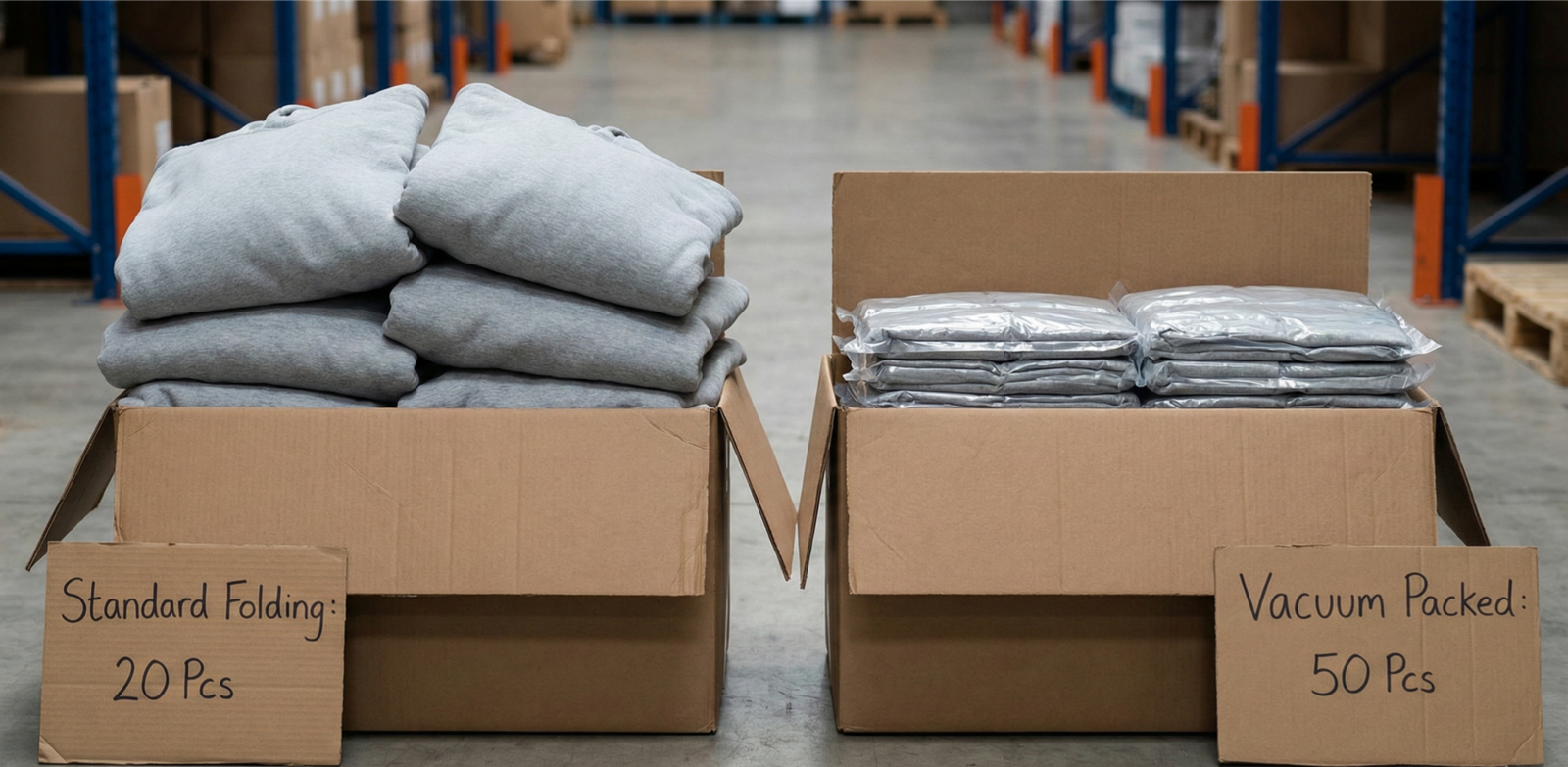
Method A: Standard Folding (The Industry Standard)
This is how most factories pack if you don’t give them specific instructions.
The Process: We folded the hoodies in half, then in thirds, and stacked them into two piles inside the box.
The Problem: The hoods are thick. The sleeves are bulky. The fabric is bouncy. After stacking about 15 hoodies, the pile started to lean and rise above the rim of the box.
The Limit: By pressing down firmly (but not damagingly), we could fit 20 hoodies in the box.
The Risk: If we tried to force in 25 hoodies, the cardboard box started to bulge outwards. Bulging boxes are dangerous. They get stuck on conveyor belts, and couriers often charge an “Oversize Handling Fee” for boxes that aren’t perfectly rectangular.
Final Count: 20 Pieces per box.
Method B: Vacuum Compression (The Optimization)
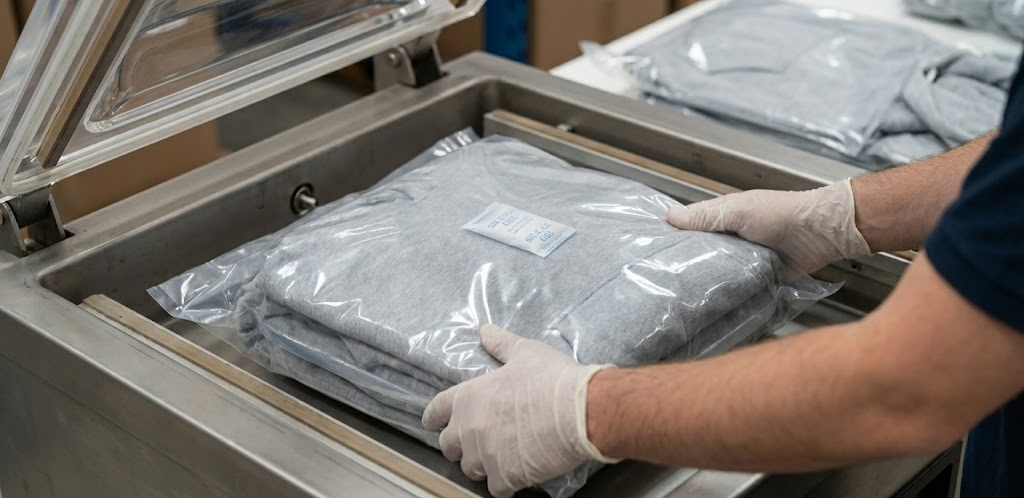
We took those same hoodies. We folded them carefully and placed them into heavy-duty PA+PE plastic vacuum bags. We used our industrial vacuum sealer to remove the air.
The Visual: The fluffy stack of hoodies turned into flat, hard “bricks.”
The Stacking: We could stack these flat packs perfectly, like books on a shelf. The friction between the bags keeps them stable.
The Limit: We comfortably fit 50 hoodies in the exact same box.
Final Count: 50 Pieces per box.
The Result
By simply removing the air, we increased the box capacity by 150%.
Standard: 20 pcs/box
Vacuum: 50 pcs/box
![Image Placeholder: A high-contrast comparison image. Left side: A cardboard box overflowing with 20 hoodies, looking messy. Right side: The same box neatly packed with 50 vacuum-sealed hoodies, looking organized. Caption: Standard Packing (20 pcs) vs. Vacuum Packing (50 pcs).]
Part 4: The Financial Impact Case Study
Saving space is cool, but saving money is what keeps your business alive. Let’s create a fictional brand, “Streetwear X,” to see how this plays out in real life.

The Scenario:
“Streetwear X” is ordering 1,000 Hoodies (380gsm) to be shipped from our factory in China to their fulfillment center in Los Angeles, California.
Total Order: 1,000 pieces.
Shipping Method: Sea Freight (LCL – Less than Container Load).
Freight Cost: Let’s assume the current rate is $150 per Cubic Meter (CBM).
Trucking/Handling: $30 per pallet/handling fee.
Scenario 1: Without Vacuum Packing (The Expensive Way)
Capacity: 20 pcs/box.
Total Boxes Needed: 1,000 ÷ 20 = 50 Boxes
Total Volume: 50 boxes × 0.072 CBM/box = 3.6 CBM
The Costs:
Ocean Freight: 3.6 CBM × $150 = $540
Destination Handling: Handling 50 boxes takes time. Let’s say it requires 3 pallets.
Local Trucking: Delivery of 3 pallets to the warehouse = ~$400.
Warehouse Storage: You now have 50 boxes taking up expensive shelf space.
Scenario 2: With Vacuum Packing (The Smart Way)
Capacity: 50 pcs/box.
Total Boxes Needed: 1,000 ÷ 50 =20 Boxes
Total Volume: 20 boxes × 0.072 CBM/box = 1.44 CBM
The Costs:
Ocean Freight: 1.44 CBM × $150 = $216 (Saved $324)
Destination Handling: Handling 20 boxes is much faster. This fits on 1 pallet.
Local Trucking: Delivery of 1 pallet to the warehouse = ~$200. (Saved $200)
Warehouse Storage: You only need space for 20 boxes.
The Bottom Line Savings
In this simple example, “Streetwear X” saved over $500 on a single order of 1,000 units.
That is an extra $0.50 profit per hoodie, achieved without raising prices or lowering fabric quality.
Note: If you were shipping via Air Express (DHL/UPS), the savings are even more dramatic. Since air freight is priced per kg, and you are avoiding the volumetric penalty, you could save upwards of $1,500 on this same shipment.
Part 5: The Science of Materials (PA vs. PE)
Not all vacuum bags are created equal. If you try to do this at home with cheap storage bags, they will leak air and re-inflate before they reach the destination.
At ZEKA Apparel, we use industrial-grade materials. It is important for you to know the difference.
The Wrong Way: Standard PE Bags
Cheap bags are made of 100% Polyethylene (PE). PE is porous on a microscopic level. Over a 30-day ocean journey, air molecules slowly seep through the plastic. The bag loses its vacuum seal, the hoodies expand, and the box bursts open from the inside.
The Right Way: PA+PE Co-Extruded Bags
We use a composite material: Polyamide (Nylon) + Polyethylene.
PA (Nylon): Provides the gas barrier. It stops air from getting in or out. It is tough and puncture-resistant.
PE (Polyethylene): Provides the heat seal capability so the bag stays closed.
Thickness: We use 10 wires (100 microns) thickness. This is double the thickness of a standard household Ziploc bag.
This material science ensures that when your box arrives in Los Angeles 40 days later, it is just as tight and compact as the day it left our factory in China.
Part 6: Will Vacuum Packing Ruin My Hoodies?
This is the “elephant in the room.” We know what you are thinking.
“If you squash my premium 380gsm hoodie flat like a pancake, will it stay that way?”
It is a valid concern. You want your customers to receive a premium product, not a wrinkled mess.
Here is the science behind why vacuum packaging is safe for Cotton, provided it is done correctly.
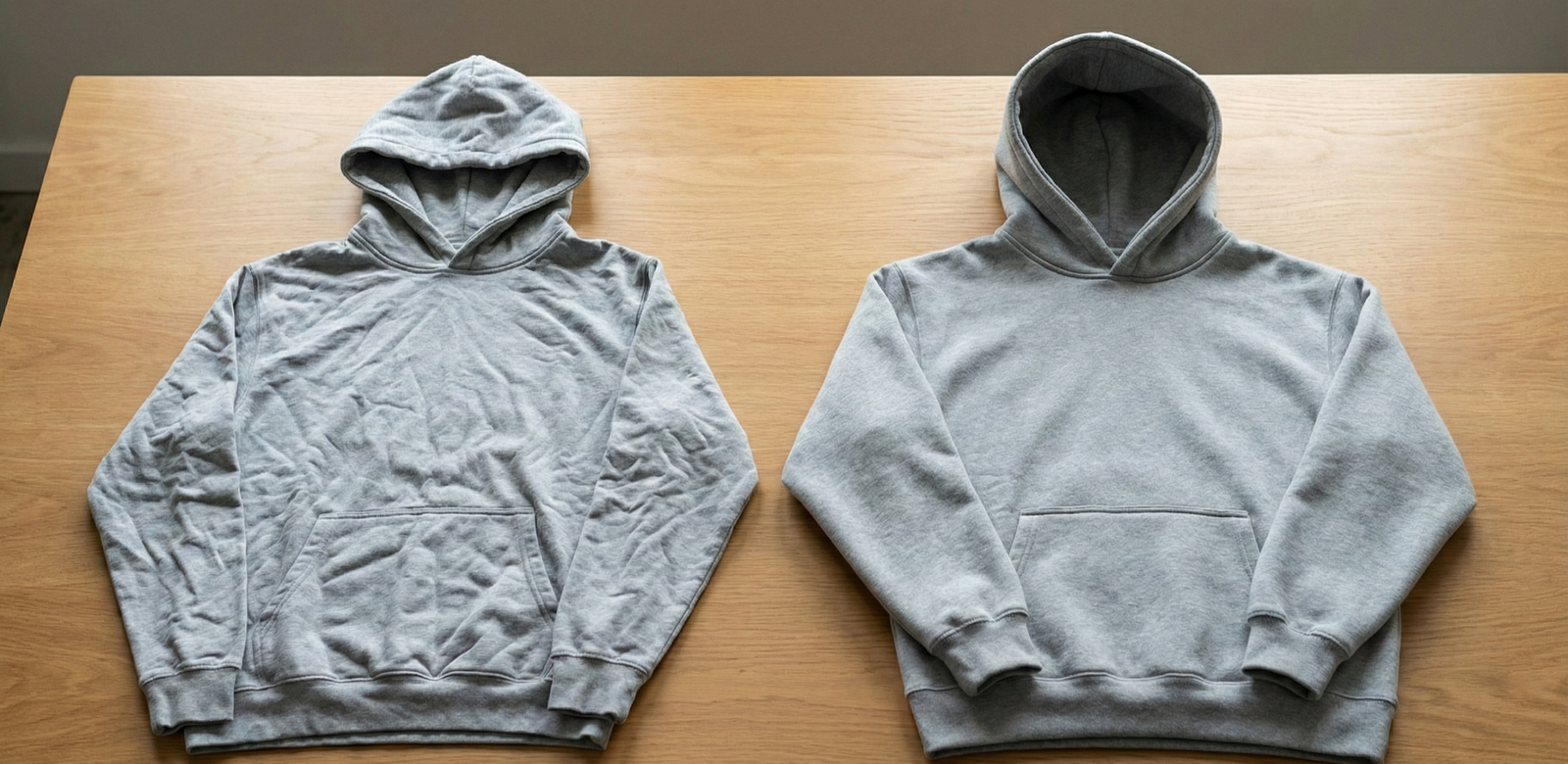
1. Cotton Has “Memory”
Synthetic fibers like cheap polyester sometimes struggle to bounce back. But Cotton is a natural cellulose fiber. It is resilient. According to Cotton Inc, cotton fibers maintain their structural integrity even under pressure, as long as high heat isn’t applied during the compression.
2. The “Steam” Factor
When you open the vacuum bag, the hoodie will look thin. It might have deep creases. This is temporary.
Upon contact with moisture (humidity in the air) or steam, the fibers swell back to their original round shape.
Test it yourself: Take a vacuum-packed hoodie. Throw it in the wash. Dry it. It will return to 100% of its original fluffiness.
3. Safety Limits
We follow strict protocols to ensure safety:
No Hard Creases on Prints: We fold the garments so that large screen prints (puff prints) are on the inside or flat surfaces, preventing the print from cracking.
Metal Zippers: We use protective paper layers over metal zippers so they don’t press into the fabric and leave permanent marks.
Part 7: The “Container Rain” Threat (And How We Stop It)
There is another hidden benefit to vacuum packaging that nobody talks about: Moisture Protection.
When a shipping container travels from a hot climate (China in summer) to a cool climate (USA/Europe), condensation forms on the ceiling of the container. This is called “Container Rain.” This water drips down onto the boxes.
If you use standard cardboard boxes with standard loose folding, that moisture can penetrate the box and make your clothes damp. Damp clothes lead to mold.
Vacuum packaging creates a hermetic seal.
Even if the cardboard box gets soaking wet, the plastic barrier protects your hoodies completely.
Our Extra Step:
We insert a Silica Gel Desiccant packet into every single vacuum bag before sealing.
Why? Even if there is a tiny amount of humidity in the air inside the factory when we pack, the silica gel absorbs it.
The Result: Your goods arrive bone-dry, fresh, and mold-free, guaranteed.
Part 8: How to Market This to Your Customers (B2B2C)
If you are a wholesaler or a brand selling directly to consumers, you might be worried about the “Unboxing Experience.”
What if your customer opens the package and thinks the hoodie is thin?
Communication is key. Smart brands turn this into a marketing advantage. Here is a strategy our successful clients use:
The “Eco-Conscious” Card
Include a small card or hangtag in the package that explains the packaging.
Sample Text:
“Why does this hoodie look thin? We used Vacuum Packaging to reduce our carbon footprint! By shrinking the package, we reduced shipping emissions and cardboard waste. Please wash or steam your hoodie to restore its premium 380gsm fluffiness.”
The QR Code Strategy
Put a QR code on the bag that links to a video of the hoodie “blooming” back to life after a steam. This creates an interactive moment and proves that the quality is high.
By framing it as an Environmental Choice, you turn a potential negative (wrinkles) into a positive brand value (sustainability).
Part 9: Comparison Table – What Can Be Vacuumed?
Not every garment is suitable for this process. Use this quick guide to decide for your other products.
| Product Type | Vacuum Safe? | Notes |
| Cotton Hoodies/Sweats | ✅ YES | The best candidate. Saves 50%+ space. |
| T-Shirts | ✅ YES | Saves about 30% space (T-shirts are already dense). |
| Puffer Jackets (Down) | ✅ YES | Saves HUGE space (80%), but requires tumbling to re-fluff. |
| Structured Caps | ❌ NO | Never vacuum. The brim will snap. |
| Blazers/Suits | ❌ NO | Will destroy the shoulder pads and lining. |
| Leather Jackets | ❌ NO | Will cause permanent cracks. |
Part 10: Environmental Impact (ESG)
Finally, let’s talk about the planet. Sustainability is no longer just a buzzword; it is a business requirement.
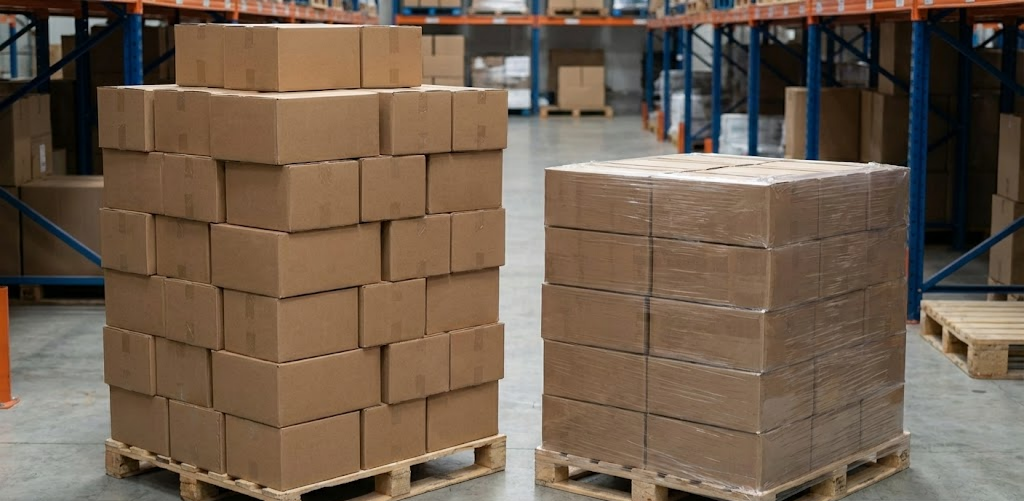
By switching from 50 boxes to 20 boxes, you are:
Reducing Cardboard Waste: You are buying, taping, and eventually recycling 60% less cardboard.
Lowering Fuel Burn: Lighter, smaller shipments mean ships and trucks burn less fuel per unit transported.
According to the US Environmental Protection Agency (EPA), corrugated boxes are the largest category of municipal waste. Reducing your box usage is a measurable way to improve your brand’s ESG (Environmental, Social, and Governance) score.
Conclusion: Don’t Let Logistics Eat Your Profits
In 2025, operating a clothing brand is hard enough. You have to worry about marketing, design, influencers, and sales. You shouldn’t have to worry about paying for “air” in your shipping boxes.
Optimizing your logistics is the “low hanging fruit” of increasing your profitability. It doesn’t require selling more product; it just requires shipping smarter.
If you are planning to produce a line of Heavyweight 380gsm Hoodies, don’t let the shipping costs scare you away. The solution is simple, effective, and proven.
Are you ready to calculate your savings?
At ZEKA Apparel, we specialize in helping small to medium-sized brands grow. We understand that every dollar saved on shipping is a dollar you can invest in your next collection.
Take the Next Step
Do you want to know exactly how much you can save on your specific order?
Send us a message with your estimated order quantity, and ask for a Free Logistics Calculation. We will provide a side-by-side quote showing you the cost of Standard vs. Vacuum shipping to your country.
Don’t ship air. Ship value.
 English